Employment law firm websitesThe clock is running. Your site should say so.
Employment law marketing starts with the page a worker lands on. They’re scared of their boss, unsure it’s a case, and they don’t know a deadline may already be running. We build the site that answers all three before they call, and we write every word. One fee, and your firm owns it the day it launches.
Four questions. Usually at midnight.
The person reading your site still works there, or just got walked out. They’re reading on a personal phone, quietly. This is what they need answered before they’ll risk a call.
- How much time do I have?
- A lot of people don't know there's a filing deadline at all. The site should tell them, in one plain line, that the clock may already be running and that a call is how they find out their date.
- Will my boss find out?
- Fear of retaliation keeps people from calling. Say who sees a message, that a first call is confidential, and that they can reach you from a personal phone, outside work hours.
- Is this even a case?
- Fired after asking for leave. Paid less than the guy hired after her. Hours cut after a complaint. Real situations, in their words, so they recognize their own.
- What will it cost me?
- If you work on contingency, say so and say what the client pays if there's no recovery. If the first call is free, say that. Money is the second question, right after time.
One page. One number.
A demo for a made-up firm, labelled Demo, and it’s live. Click around.
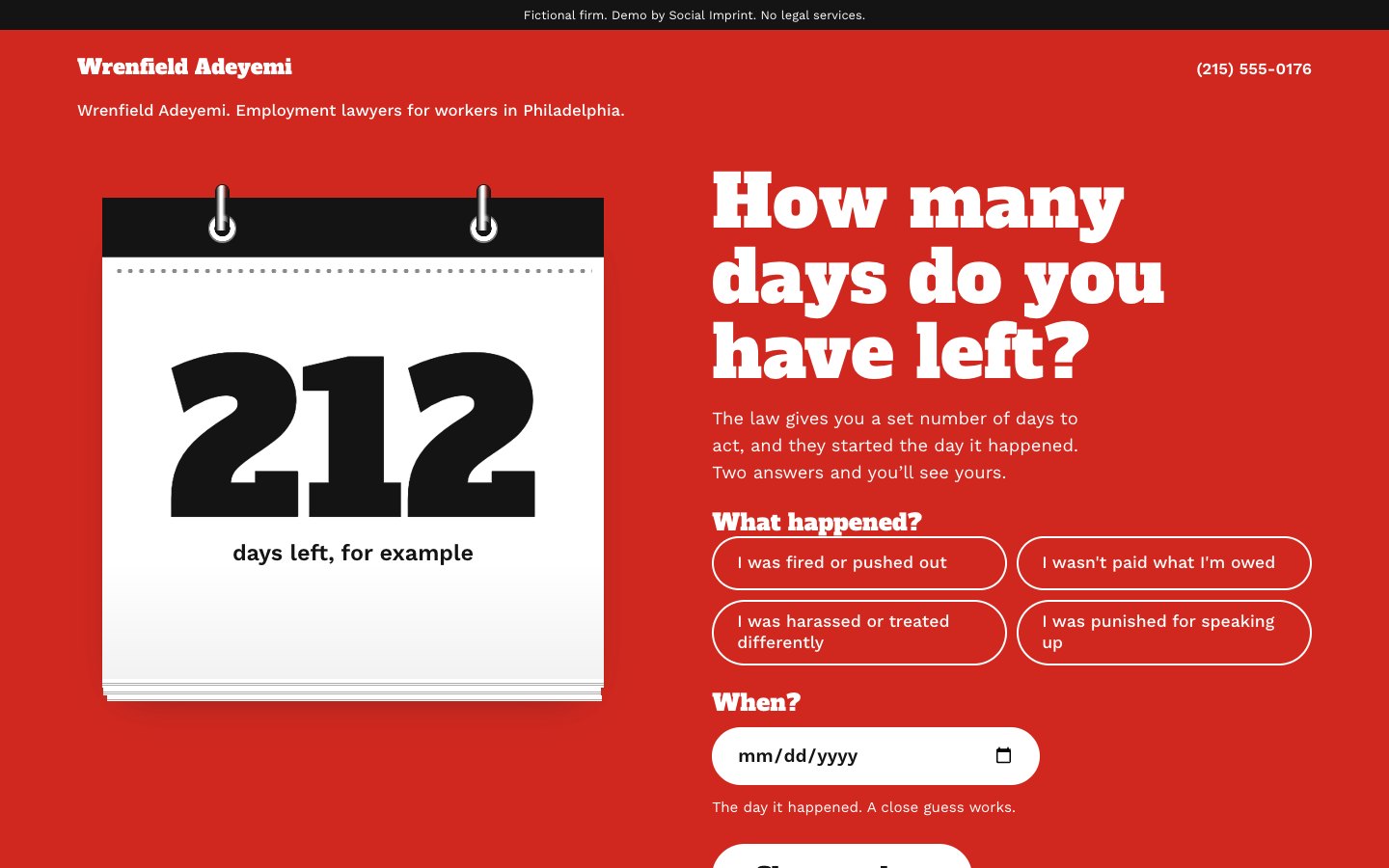
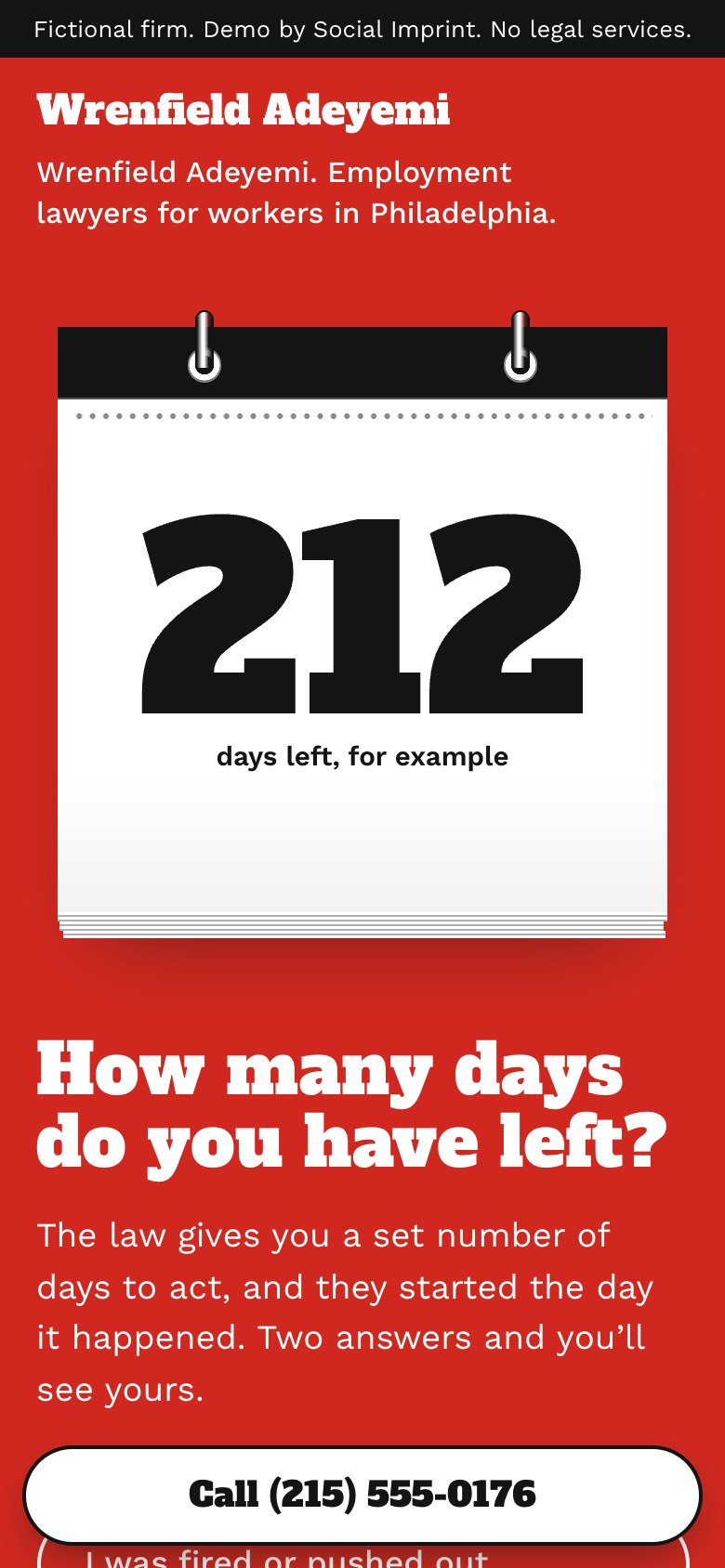
Wrenfield Adeyemi
A day pad that tears down to the days you have left.
An employment firm in Philadelphia, on the worker’s side. The visitor answers two questions, what happened and when. Pages tear off a pad and it stops on their number, with the date it lands on and one thing to do this week. The same number waits at the bottom, next to the phone.
- The deadline is the first thing on the page, not the last
- What they told you, next to what the law says, side by side
- A three-field callback form, and a call button that stays on phones
A scared visitor doesn’t scroll.
Six jobs the site does for an employment practice, most of them before the first fold.
Put the deadline up front
Not a paragraph on page four. A plain line near the top that says many claims have short deadlines, and an easy way to find out theirs. The demo above turns it into the page itself.
Make the first contact feel safe
A short form that asks for a name, a personal phone or email, a good time to call and one line about what happened. A notice above it, in words you approve, about what not to send yet.
Write it for the worker, not the lawyer
“Wrongful termination” is your word. “I got fired right after I complained” is theirs. The site uses both, so search finds it and people recognize themselves.
Show which side you're on
Workers want to know you don't also represent their employer. If you only take workers' cases, it goes in the first screen. If you represent companies, that's a different site with a different reader.
Say what happens after they write
Who calls back, how fast, and what the first call covers. Uncertainty is what keeps a scared person from pressing send.
Work on a phone, on a break
Big type, short pages, a call button that stays on screen. Assume they're reading in a parking lot on a break.
Deadlines, said carefully.
Federal discrimination charges have short time limits. The EEOC’s own page on time limits says a charge generally has to be filed within 180 calendar days, extended to 300 in many places. State claims and wage claims run on other clocks.
Say that the clock exists
Plainly, near the top. Someone who waits too long can lose the claim, and plenty of people don’t know the clock exists.
Never promise the date
The real deadline depends on the facts. The page says so, and the call is where they find out. You approve the wording.
Point to the official source
A link to the agency’s own page does more for trust than a paragraph of ours.
Make the next step tiny
A call or a three-field form. Not a questionnaire about a job they’re afraid to lose.
You shouldn’t need a call to hear a price.
Priced by pages, paid once. Most employment firms pick the size by how many claim types get their own page.
One page, one job
Stamp
$2,000
A deadline page, a single claim type or a page for your ads. Wrenfield Adeyemi is this size.
1 page · 2 weeks · 2 revision rounds
A small firm site
Mark
$3,500
Home, the claims you take and how to reach you. Three pages, done right.
Up to 3 pages · 2 to 3 weeks
A full firm site
Signature
$6,000
A page per claim type, the lawyers, what to expect and contact. Up to five pages.
Up to 5 pages · 3 to 4 weeks · 2 revision rounds
Every build includes the custom design, every word of copy written for you, the technical SEO foundation, your Google Business Profile set up, analytics and contact forms. No monthly fee to us. Hosting is in your name, about $20 a month.
Want someone to keep it up to date? Care plan, $199 a month: hosting looked after, forms checked, and up to 5 small changes a month. Cancel anytime. The site stays yours.
Already have a site that works but looks dated? A site refresh puts a new design on the pages you have, $3,000. Everything else is on the law firm pricing page.
Here’s the plan.
Luis Paoli, who founded Social Imprint, designs and builds every site. Your part is the facts, the photos and the approvals.
You write to us
A two-minute form. You’ll hear back within a business day.
A questionnaire, then a kickoff call
Your practice, the claims you take, who you won't represent, and what people ask on every first call.
We look at what your clients see
The firms that show up when a worker in your city searches. Then we decide what your site needs and what it doesn’t.
Three designs to choose from
Real directions, not one design in three colors. You pick one.
We write every word. You approve every word.
Plain language, the responsible lawyer named, and the notices your state asks for.
Launch, in your name
The site goes live on your domain, on hosting in your name. It’s yours from that day.
Built around your state’s rules. Approved by you.
The responsible lawyer named on every page. No guarantees, no “best,” and the contingency and cost lines in plain words. You approve every word before it goes live, because the compliance call is yours. The map is in our guide to attorney advertising rules for websites.
Yours the day it launches.
The domain and the hosting are in your firm’s name. No monthly fee to us, no contract that keeps the site if you leave. Before you sign with anyone, read who owns your law firm website.
Questions employment lawyers ask
What should an employment law firm website have?
A plain line about deadlines near the top, the situations you take in the worker's own words, a clear statement of whose side you're on, what a first call costs, and a short, private way to reach you from a personal phone. On every page: the responsible lawyer, the office and the phone number.
Can the website tell people their filing deadline?
It can show how deadlines work and send people to the official source. The EEOC, for example, publishes its own page on time limits for filing a charge. A tool like the Wrenfield Adeyemi day pad can count from a date the visitor picks, as long as the page says plainly that the real date depends on their facts and the call is where they find it out. You approve the wording.
How do we handle confidentiality on the contact form?
Keep the form short: name, a personal phone or email, a good time to call, one line on what happened. Put a notice above it, in words you approve, saying a message doesn't make someone a client and asking them not to send documents yet. Nothing gets stored on the site. Messages go to your inbox.
Is one page enough for an employment law firm?
It can be. A single page built around one job, like the Wrenfield Adeyemi deadline page, is a Stamp: one page, $2,000. Firms that want a page per claim type, the lawyers and a contact page usually pick Mark (up to 3 pages, $3,500) or Signature (up to 5 pages, $6,000).
What about employment law marketing beyond the website?
The site comes first, because every ad, post and referral sends people there. We also run social media and YouTube at the same prices as for real estate agents, from $1,900 a month and $3,000 a month. We've run social for real estate agents since 2021. We haven't run it for a law firm yet, so we won't promise you law results.
Does the site follow attorney advertising rules?
We build around your state's advertising rules: the responsible lawyer named, no guarantees, no superlatives, fee and cost lines in plain words. You approve every word in writing, because the compliance call is yours and your bar's. Our guide to attorney advertising rules is the map.
Who owns the site?
Your firm does, from the day it launches. The domain and the hosting are in your name, about $20 a month for hosting. No monthly fee to us. The care plan is optional.
Nobody else has your fingerprint. Why do they have your website?
Take it back. It starts with a two-minute form, not a sales call.