Estate planning law firm websitesNobody’s in a hurry to plan for dying. Give them a reason.
Most people put off a will for years. An estate planning law firm website has one job: give them a reason to start this week. Plain answers, their own family on the screen, the fee on the page, and a first step that doesn’t feel like a commitment. One fee, and your firm owns the site the day it launches.
Four people land on your site.
They want different things, on different days. A good estate planning site knows which one just arrived.
The new parents
Somebody asked who gets the kids, and nobody had an answer. They want to know what a will does and what it costs, without a two-hour meeting.
The adult children
Mom and Dad are getting older, nothing is written down, and they're the ones doing the research. They need something they can send to their parents.
The family after a death
Somebody died, and now there's a house, an account and a court they've never heard of. They need the probate side of the firm, in a calmer voice.
The second marriage
Kids from before, a house from now, and a real worry about who ends up with what. They need to see their own situation, not a generic one.
What gets a family off the fence.
Not another page on “why estate planning matters”. They know it matters. That’s why they’ve been avoiding it.
Show what happens without a plan
In plain words, for your state, with the law named. “If you died tomorrow with no will” does more work than a page about the importance of planning.
Let them see their own family
A married couple with two kids and a blended family of five need different answers. A site can ask two or three questions and show the one that fits.
Put the fees on the page
If your plans are flat fee, say so, with the number. The price is the question every visitor has and the one most firm sites dodge.
Explain every document in one line
Will, trust, power of attorney, health care proxy. One plain sentence each, then the detail for anyone who wants it.
Offer a first step that isn't a commitment
A free class, a short intro call, a checklist. Nobody books a meeting about their own death on the first visit.
Give probate its own door
The family after a death is a different reader on a different day. They shouldn't have to scroll past a sales pitch for trusts to find out what to do next.
Three estate sites, three sizes.
Each one is a demo for a made-up firm, labelled Demo, and each one is live. Start with the Family Map. Put your own family in it.
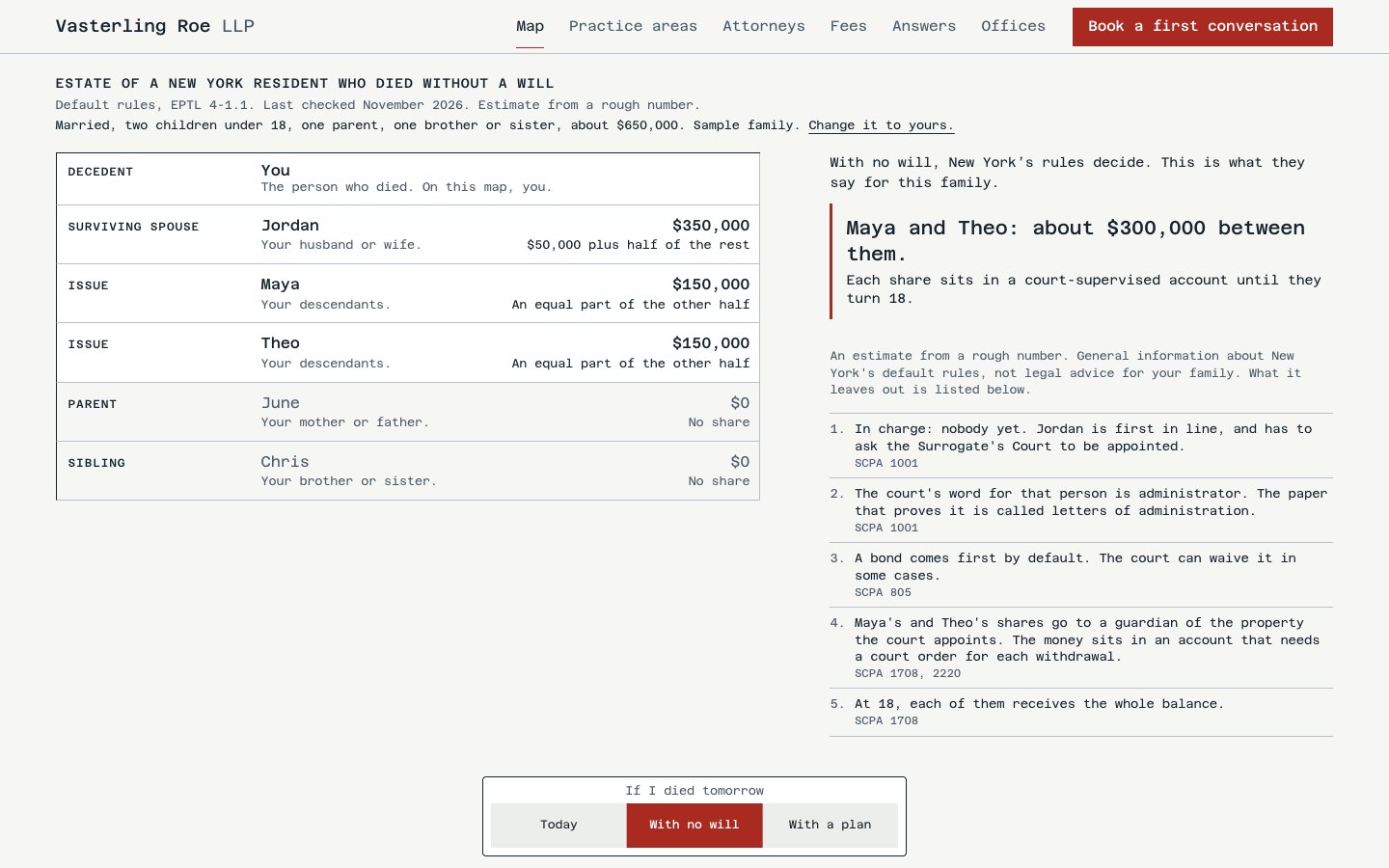
Vasterling Roe LLP
Put your family on a map. Flip one switch.
A wills, trusts and estates firm in New York. Visitors replace the sample family with their own, flip “if I died tomorrow with no will”, and the page turns into a court form that shows who would inherit under New York law. Then they see which documents fix it, with the flat fee, and book with the map attached. 26 pages.
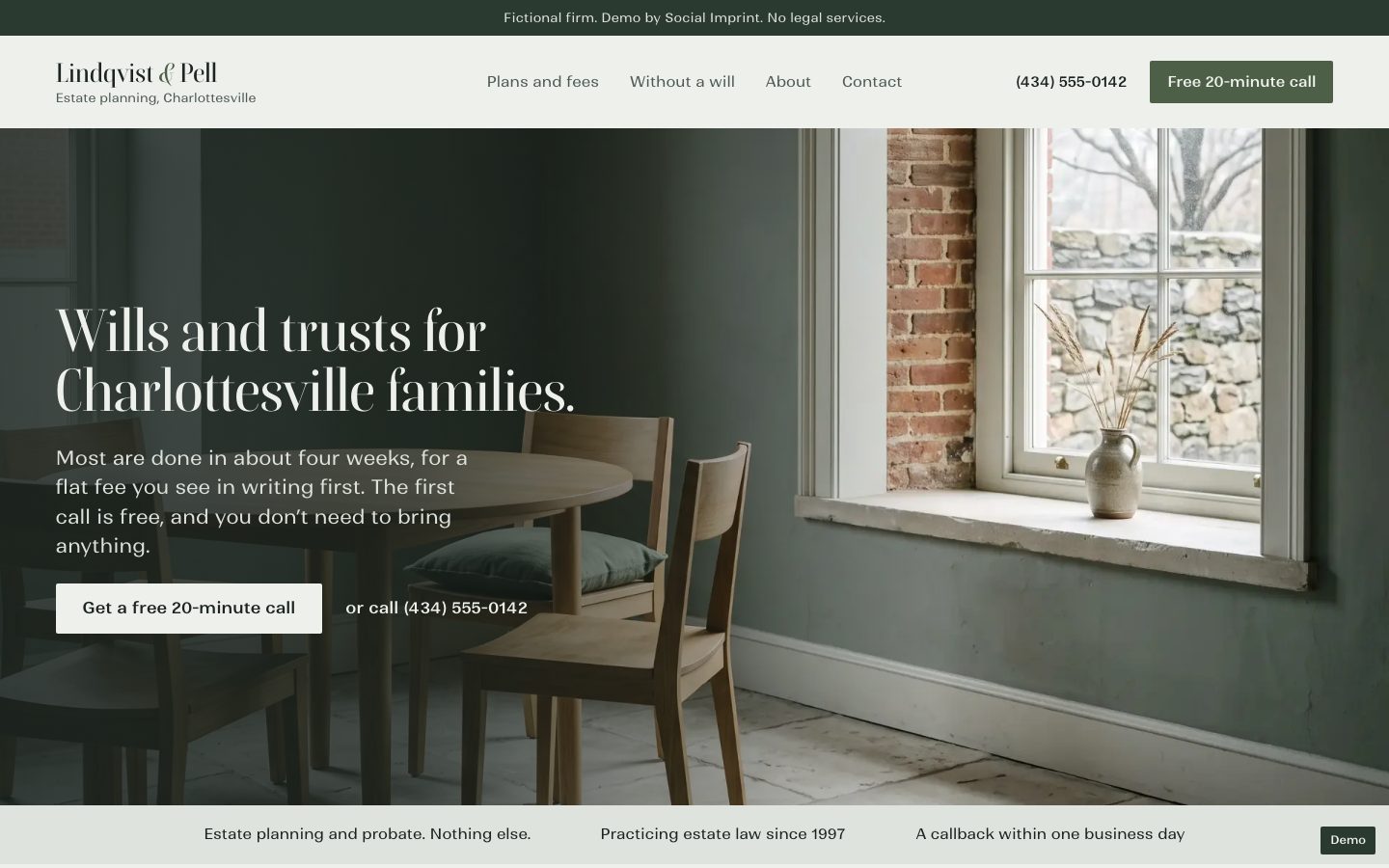
Lindqvist & Pell
Your family, in one sentence.
A small estate planning firm in Charlottesville, Virginia. Families describe themselves in a sentence and see, in plain words, what Virginia would do with their house and their kids without a will. Flat-fee plans and a free intro call. Five pages.
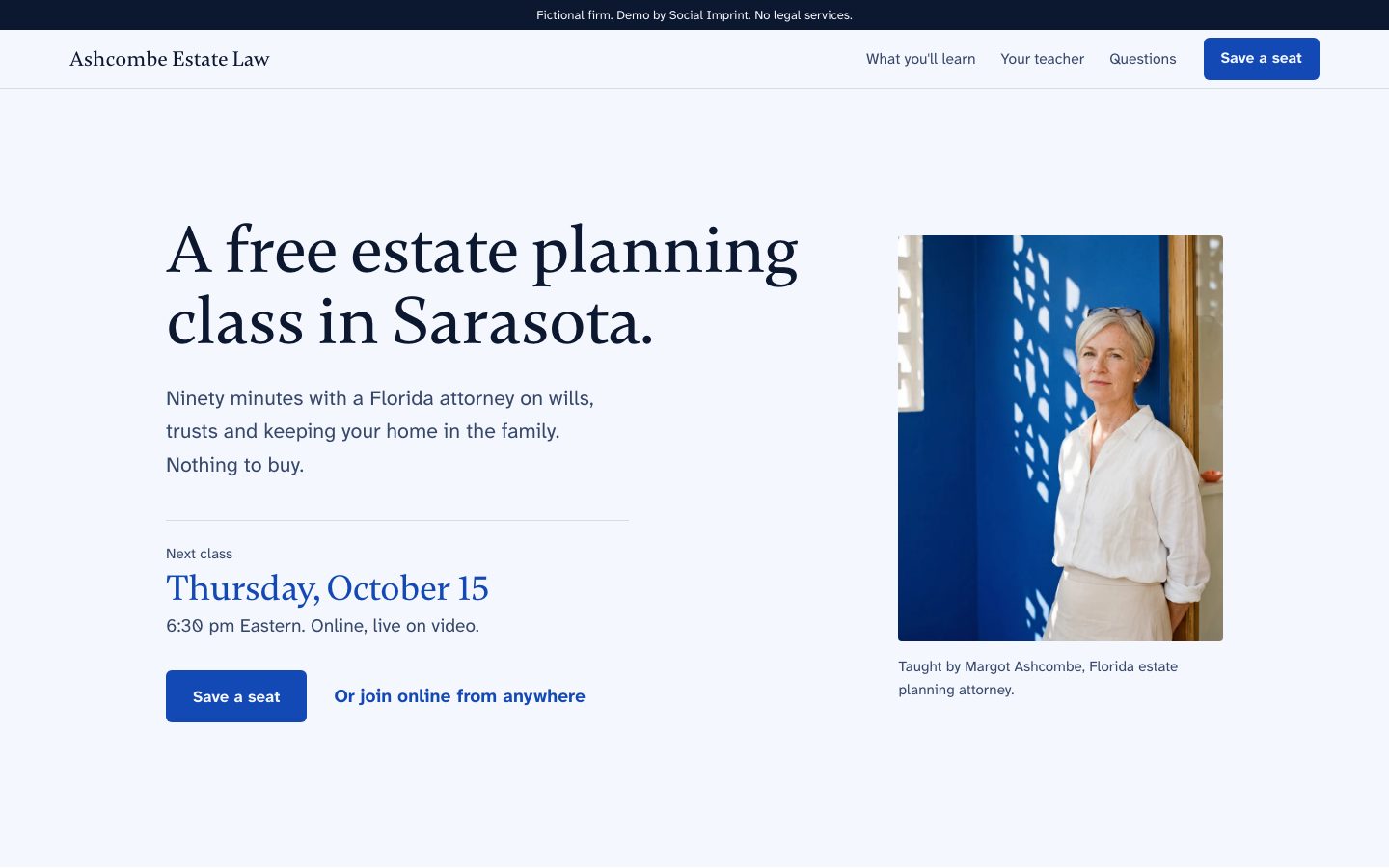
Ashcombe Estate Law
Fill the free class.
An estate planning firm in Sarasota with a free monthly class. One page says what the class is, who teaches it, when it is, in person or online, and a seat takes seconds.
A tool beats a blog post. If it’s right.
Showing a family who would inherit explains intestacy faster than two thousand words about it. It also means the site is making a legal statement, so it gets built like one.
- It has to be right
- A tool that says who inherits is a legal statement. It gets built from your state's statute, checked against test cases, and read by a lawyer at your firm before it goes live. The Family Map demo's calculator runs against a set of test cases written from New York law.
- The notice sits next to the answer
- “General information, not legal advice” belongs right under the result, where the reader meets it, not in the footer.
- It doesn't collect more than it needs
- Decide up front what the tool keeps. A family tree is private. If it travels with a booking, the visitor should know that before they send it.
- It ends at a person
- Every result points to the next step: the documents that fix it, the fee, and a time to talk.
You shouldn’t need a call to hear a price.
Fitting, for a practice that sells flat fees. Priced by pages, paid once.
Stamp
$2,000
A class sign-up or one campaign page, like Ashcombe.
1 page · 2 weeks
Signature
$6,000
A full firm site: plans and fees, probate, the lawyers, contact. Lindqvist & Pell is this size.
Up to 5 pages · 3 to 4 weeks
Imprint
$9,500
More practice areas, more lawyers, more to explain.
Up to 10 pages · 4 to 6 weeks
Seal
from $25,000
A firm site with a working tool and dozens of pages, like the Family Map.
Unlimited pages · 8 to 12 weeks · Quoted
Every build includes the custom design, every word of copy written for you, the technical SEO foundation, your Google Business Profile set up, analytics and contact forms. No monthly fee to us. Hosting is in your name, about $20 a month.
Want someone to keep it current? Care plan, $199 a month: hosting looked after, forms checked, and up to 5 small changes a month. Cancel anytime. The site stays yours.
Add-ons and payment terms are on the law firm pricing page.
Here’s the plan.
Luis Paoli, who founded Social Imprint, designs and builds every site. Your part is the facts, the fees and the approvals.
You write to us
A two-minute form. You’ll hear back within a business day.
A questionnaire, then a kickoff call
Your plans, your fees, your first meeting, who your clients are and what they ask.
We look at what families find
The firms that show up when your clients search. Then we decide what your site needs and what it can skip.
Three designs to choose from
Real directions. You pick one.
We write every word. You approve every word.
Every document explained, every legal statement checked by your firm, every notice where it belongs.
Launch, in your name
Live on your domain, on hosting in your name. Yours from that day.
Built around your state’s rules. Approved by you.
The responsible lawyer named, no superlatives, notices placed with the things they qualify. You approve every word before it goes live, because the compliance call is yours. The plain-words map is our guide to attorney advertising rules for websites.
You draft wills for a living. Read this contract.
The domain and the hosting are in your firm’s name from launch day. No monthly fee to us, and no clause that keeps the site if you leave. Before you sign with anyone, read who owns your law firm website.
Questions estate planning lawyers ask
What should an estate planning law firm website include?
A plain answer to what happens without a plan in your state. One-line explanations of each document. Your fees, if they're fixed. A first step that isn't a commitment, like a free class or a short call. And a separate path for families dealing with probate after a death.
Should an estate planning firm put its fees on the website?
If your plans are flat fee, showing the number answers the question every visitor has. Your state's advertising rules still apply to how fees are described, so the wording goes through you before it's published.
Can our site have a tool like the Family Map?
Yes. The Family Map demo is the biggest build we offer, a Seal. Tell us what you'd want a tool to do and we'll tell you which size it fits before you sign anything. A smaller version, like Lindqvist & Pell's family sentence, fits a five-page site.
Is a page for a free estate planning class worth it?
If you run a class, it's one of the easiest first steps to offer. A sign-up page like Ashcombe Estate Law's is a Stamp: one page, $2,000.
What does an estate planning law firm website cost?
It's priced by pages, paid once. One page is $2,000. Up to 5 pages is $6,000. Up to 10 pages is $9,500. A larger firm site starts at $25,000, quoted. There's no monthly fee to us, and the care plan is optional at $199 a month.
Does the site follow attorney advertising rules?
We build around your state's advertising rules: the responsible lawyer named, no superlatives, notices next to the things they qualify and above the forms. You approve every word in writing. The compliance call stays with you and your bar.
Who owns the site?
Your firm does, from the day it launches. The domain and the hosting are in your name. Stop the care plan and the site stays exactly where it is.
Nobody else has your fingerprint. Why do they have your website?
Take it back. It starts with a two-minute form, not a sales call.