Immigration law firm websitesTwo languages. One number they can trust.
An immigration law firm website gets read by scared people, often in Spanish first, often on a phone, sometimes right after a stranger called pretending to be you. We build it in both languages, make your real number easy to verify, and write every word. One fee, and your firm owns the site the day it launches.
The family reads it before they call.
Often it’s not the client. It’s a daughter, a husband, a cousin who reads English, checking you out on a phone at the kitchen table. This is what they’re looking for.
- Their language, on every page
- Not a Spanish button that opens a single translated page. The whole site, with the same pages, the same forms and the same answers in both languages. Switch on the fees page and you stay on the fees page.
- Proof the number is really yours
- Your clients get calls, texts and messages from people pretending to be their lawyer. The site lists every real number, email and profile, says what the firm never does, and tells them where to report the rest.
- Plain answers before the call
- What the first consultation costs, how long it takes, what to bring, and what happens next. In short sentences a nervous person can read on a phone.
- A person, and how to reach them
- Who answers, when, and how: phone, text, WhatsApp if you use it, a callback form that asks only for a name, a number and one line.
A translate button isn’t a bilingual site.
Plenty of firm sites say “se habla español” and then send a Spanish reader to an English contact form. Here’s what a real bilingual law firm website does.
Written in Spanish, not run through a translator
Clients can tell. A machine-translated page reads like a form letter from a government office, which is the last thing an immigration client needs.
Both versions are the real site
Every page exists in both languages, with its own address. Page names are translated too: casos and cases, consulta and consultation.
The switch keeps your place
Change language on any page and you land on the same page in the other language, not back on the home page.
It remembers
Pick a language once and the site opens in it next time.
Google knows which is which
Each page tells search engines its language and points to its twin, so a Spanish search finds the Spanish page.
Names spelled right
Accents and tildes in the firm name, the lawyers’ names and the address. Villaseñor, not Villasenor.
Three bilingual sites. Click around.
Each one is a demo for a made-up firm, labelled Demo, and each one is live. Open them in Spanish first. That’s how most of their visitors would.
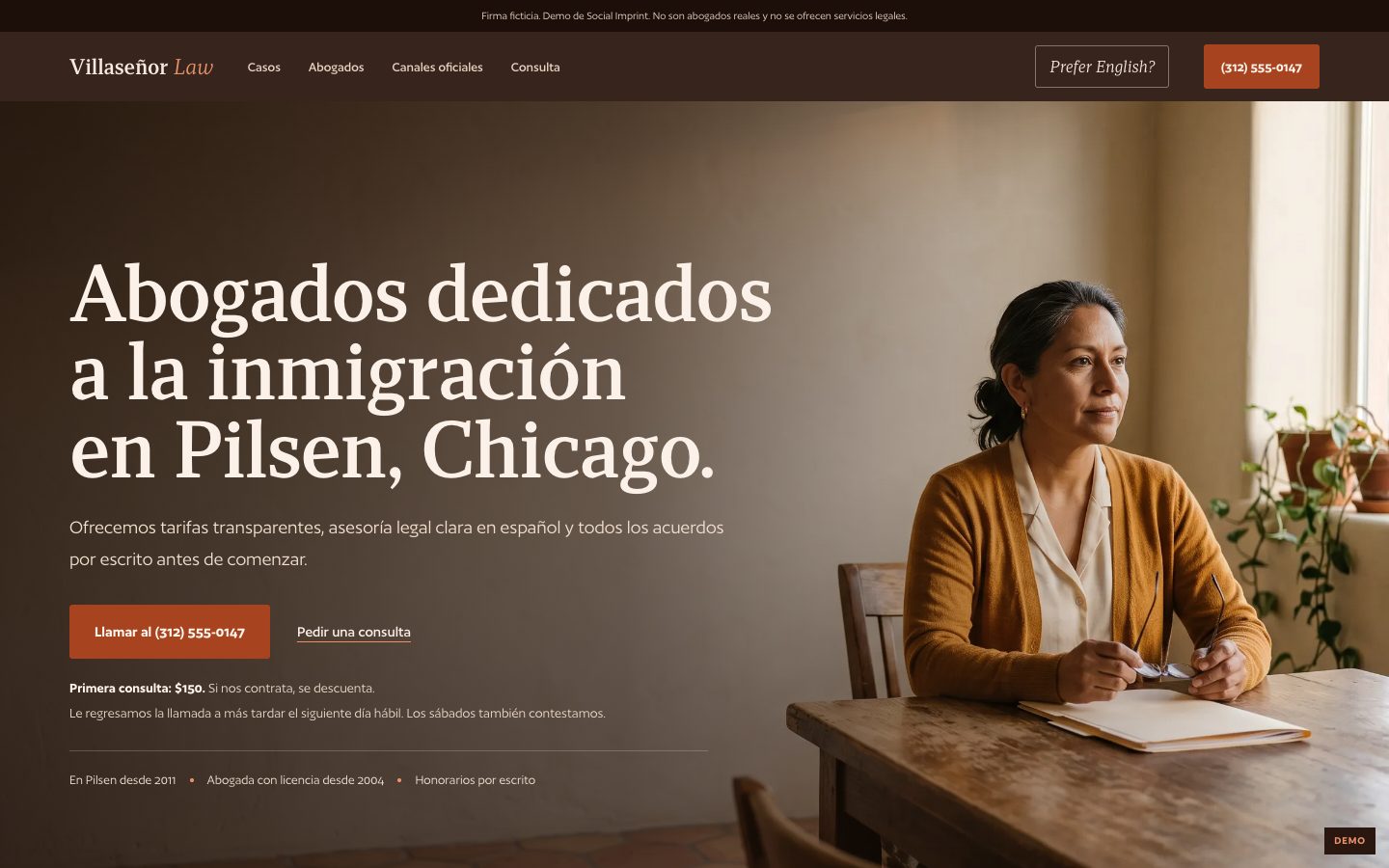
Villaseñor Law
Spanish first, five pages, both languages.
A two-lawyer firm in Chicago. The site opens in Spanish, remembers the language a visitor picked, and the switch keeps them on the page they were reading. The page names are translated too, so the address reads right in both.
- The “Is this really us?” checker: paste a number, email, link or payment request and it says whether it belongs to the firm
- What the firm never asks for, and where to report a scam
- The first consultation fee and a callback, right under the button
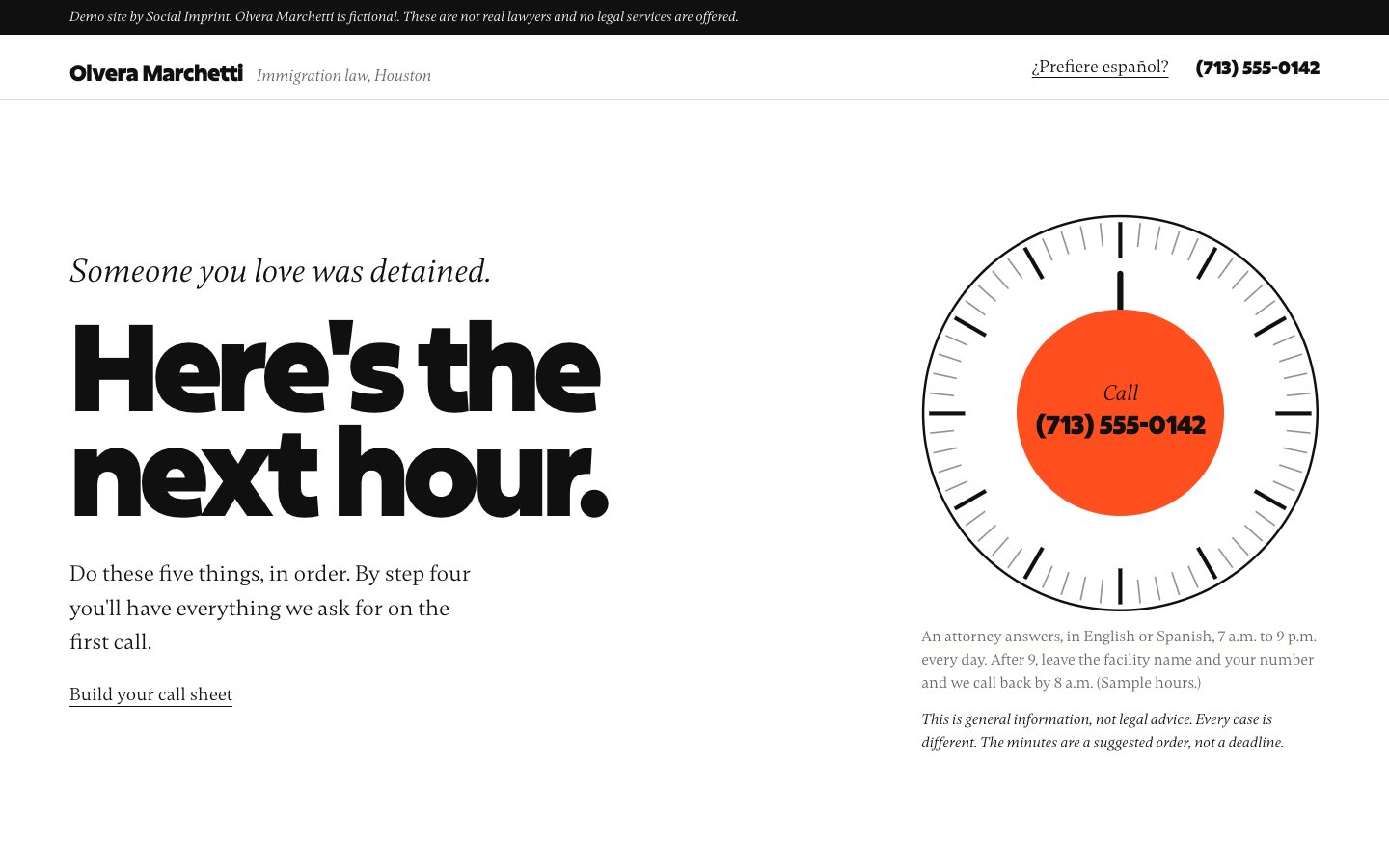
Olvera Marchetti
One page for the worst hour.
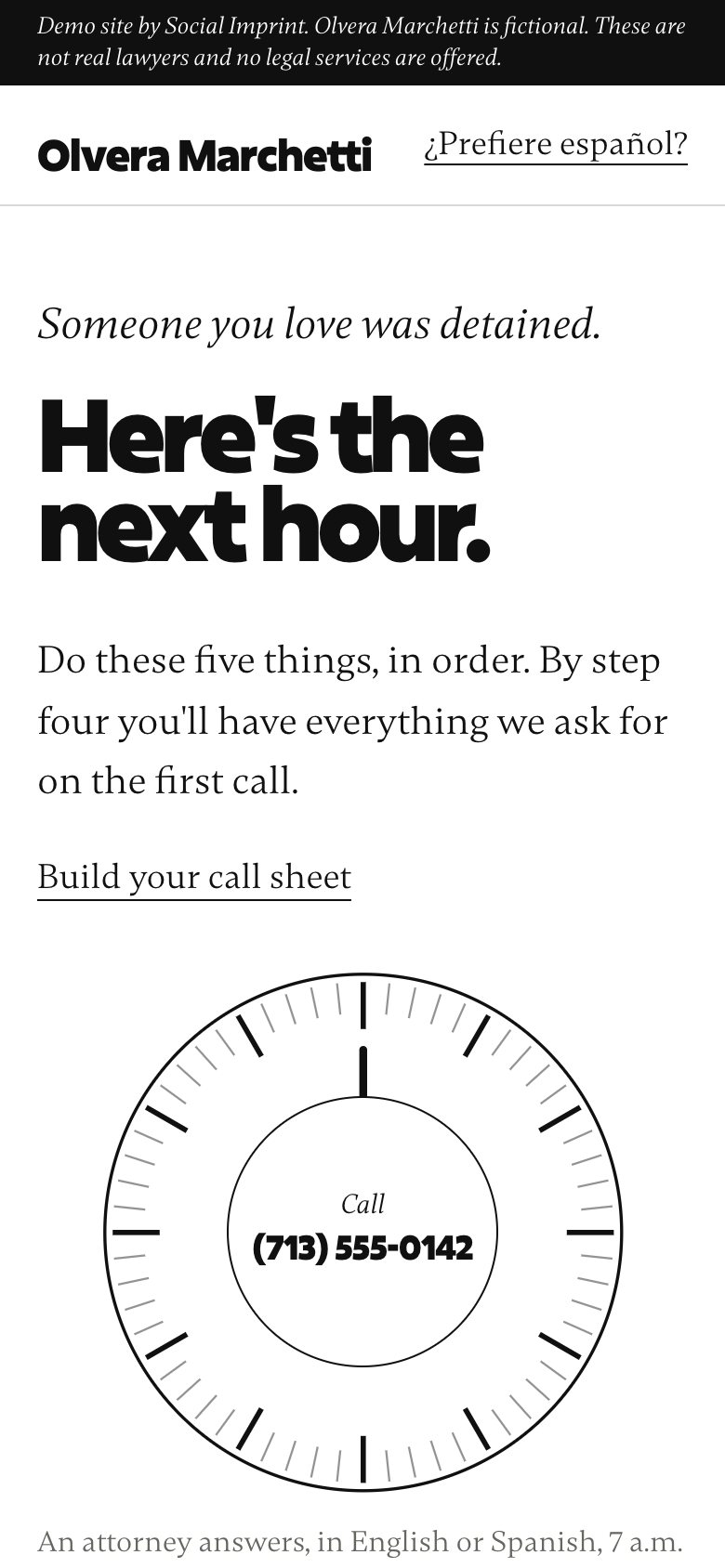
An immigration firm in Houston, built for the hour after someone in the family is detained. It opens in Spanish and walks the family through that hour, step by step, with the call button always on screen.
- A call sheet: five quick answers become the first thing to say on the phone
- Switch languages and the answers come along, in that tab only
- A “call only this number” section, so a stranger can’t step in
Zaldívar Roane
A different practice. The same reader.
An injury firm in Phoenix, fully in English and Spanish. It isn’t immigration, but it shows the same thing: a Spanish-speaking client deciding whether to call, on a site that was written for them, not run through a translator.
- Every page in both languages, with the switch on every page
- A settlement check that tears into who gets what
- Forms and answers in the language the visitor chose



Their first question isn’t legal.
It’s “is this really my lawyer?” Immigration clients are a favorite target for people who fake a firm’s name, its caller ID, even its website. Government agencies publish warnings about it, like the USCIS page on avoiding scams. Your site can answer the question before anyone gets hurt.
An official channels page
Every number, email, website and social profile that belongs to the firm, in one place, in both languages.
What you never do
For example: ask for payment by gift card or wire to a personal account, promise a result, or contact clients from an unlisted number. Whatever your firm never does, the site says it plainly.
Where to report it
Links to the government pages for reporting fraud and for checking who is allowed to help with an immigration case.
One number everywhere
The same number on the site, the Google profile, the business cards and the voicemail, so the real one is easy to recognize.
You shouldn’t need a call to hear a price.
Priced by pages, paid once. Most firms pick the size by how many practice areas and languages they need on their own pages.
One page, one job
Stamp
$2,000
A Spanish-first page for one moment, like a detention page or a consultation offer. Olvera Marchetti is this size.
1 page · 2 weeks · 2 revision rounds
A full firm site
Signature
$6,000
Home, practice areas, the lawyers, official channels and contact, in both languages. Villaseñor Law is this size.
Up to 5 pages · 3 to 4 weeks · 2 revision rounds
A bigger firm
Imprint
$9,500
Up to ten pages for more practice areas, more lawyers and more to explain. Zaldívar Roane is this size.
Up to 10 pages · 4 to 6 weeks · 3 revision rounds
Every build includes the custom design, every word of copy written for you, the technical SEO foundation, your Google Business Profile set up, analytics and contact forms. No monthly fee to us. Hosting is in your name, about $20 a month.
Want someone to keep it up to date? Care plan, $199 a month: hosting looked after, forms checked, and up to 5 small changes a month. Cancel anytime. The site stays yours.
The whole list, including add-ons, is on the law firm pricing page.
Here’s the plan.
Luis Paoli, who founded Social Imprint, designs and builds every site. Your part is the facts, the photos and the approvals.
You write to us
A two-minute form. You’ll hear back within a business day.
A questionnaire, then a kickoff call
Your practice, your clients, the languages they read, the questions they ask on every first call.
We look at what your clients see
The firms that show up when your clients search, in both languages. Then we decide what your site needs and what it doesn’t.
Three designs to choose from
Real directions, not one design in three colors. You pick one.
We write every word. You approve every word.
In both languages, with the licensing lines and the notices your state asks for.
Launch, in your name
The site goes live on your domain, on hosting in your name. It’s yours from that day.
Built around your state’s rules. Approved by you.
Your licensing, said plainly and positively. The responsible lawyer named. Notices above the forms, in words you choose. You approve every word before it goes live, because the compliance call is yours. The map is in our guide to attorney advertising rules for websites.
Yours the day it launches.
The domain and the hosting are in your firm’s name. No monthly fee to us, no contract that keeps the site if you leave. Before you sign with anyone, read who owns your law firm website.
Questions immigration lawyers ask
What should an immigration law firm website have?
The whole site in the languages your clients read, with a switch that keeps the page. A clear way to check which numbers and channels are really the firm's. Plain answers on fees, the first consultation and what to bring. And a person to reach, with the hours and the ways to reach them on every page.
Is one Spanish page enough?
For a start, it can be. A single Spanish-first page for one job, like Olvera Marchetti, is a Stamp: one page, $2,000. If most of your clients read Spanish first, though, a whole site in both languages tells them they're the main audience, not a guest.
Who writes the Spanish?
We write every word of the site, in both languages, and you approve every word before it goes live. If someone at your firm reads the Spanish closely, they review it too. Nothing gets published that your firm hasn't signed off on.
Can the site help protect clients from scams?
Yes. It can list every real number, email and profile, say what the firm never asks for, check a message against the firm's real channels, and link to the official pages for reporting fraud. Villaseñor Law shows all of it.
What does an immigration law firm website cost?
It's priced by pages, paid once. One page is $2,000. Up to 5 pages is $6,000. Up to 10 pages is $9,500. There's no monthly fee to us. Hosting is in your name, about $20 a month, and the care plan is optional at $199 a month.
Does the site follow attorney advertising rules?
We build around your state's advertising rules: the responsible lawyer's name and contact details, licensing lines in plain words, notices above the forms, no superlatives. You approve every word in writing. The compliance call stays with you and your bar.
Who owns the site?
Your firm does, from the day it launches. The domain and the hosting are in your name, and you can take the site anywhere. If you stop the care plan, the site stays exactly where it is.
Nobody else has your fingerprint. Why do they have your website?
Take it back. It starts with a two-minute form, not a sales call.