Personal injury law firm websitesEverybody fights for you. Show them the check.
Every injury firm says it fights for you. The injured person has heard it on the bus bench and the radio all week. What they don’t know is what they’d take home, and nobody’s site shows them. We build the one that does, in their language, with the call one tap away. One fee, and the firm owns the site the day it launches.
They find you on a bad day.
A personal injury website gets read at four moments. Each one asks a different question. A good site answers all four without making anyone scroll for it.
Day one
In a hospital bed or a tow lot
One hand, a cracked phone, a lot of pain. They need the number and one sentence that says calling costs nothing.
Day three
After the insurer called
Someone offered them a number and asked for a recorded statement. They want to know if they should wait.
Week two
With the bills on the table
Now it's money. What does a lawyer take, who pays the hospital, and what's left for them.
Any day
Reading for someone else
A daughter or a husband, often in Spanish, deciding which firm the family calls.
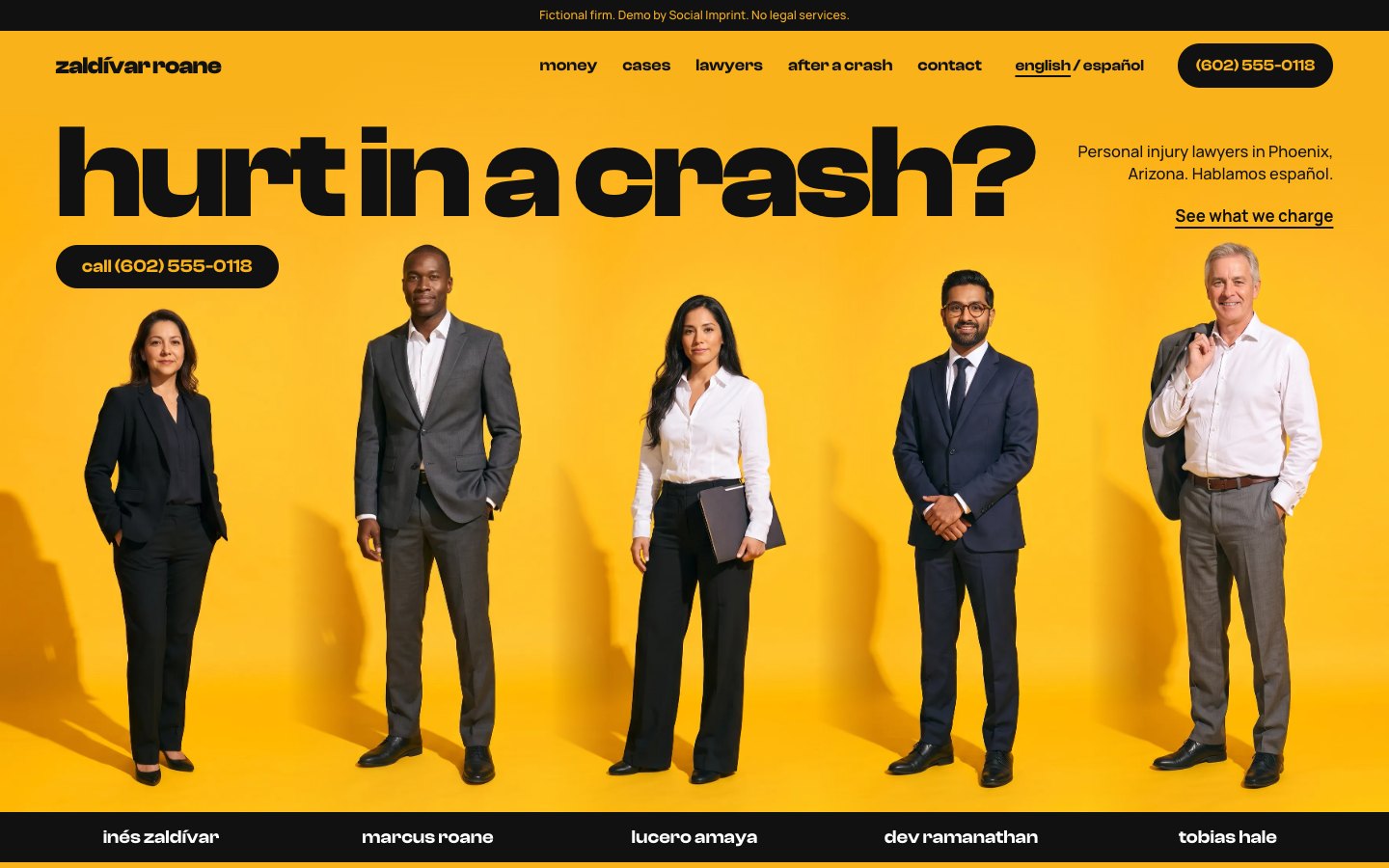

Zaldívar Roane
A five-lawyer injury firm in Phoenix, in English and Spanish. Made up, labelled Demo, and fully working. Open it and pick a settlement amount.
The check tears
Pick a settlement amount and a paper check tears into who gets what: the firm's fee, the case costs, the medical bills, and the client. The question every injured person has, answered before the call.
The lawyers on the wall
Five lawyers standing on one yellow wall, each with a page. Not a stock photo of a handshake. The people who'd pick up.
After a crash, printable
A plain list of what to do in the days after a crash, laid out to print.
Every page in two languages
English and Spanish, the whole site, with a switch on every page. The forms and answers follow the language the visitor picked.
The call, always there
On a phone the call button stays pinned to the bottom of the screen. Nobody hunts for the number.
Room to explain
Home, the money, the cases, the lawyers with a page each, after a crash, and contact. An injury firm has a lot to explain, and each part gets its own page.
The first screen, in order.
Most visitors decide before they scroll. These five things go above the fold, top to bottom.
What you handle, in their words
Car wreck, truck crash, a fall, a dog bite. Not “we fight for you”. Every firm says that.
The fee, said plainly
If you work on contingency, say what that means in one line, with the costs explained the way your state's rules require.
A phone number they can tap
Big, at the top, and pinned on phones. Calls are the lead that matters most in this practice.
A person
A real face from the firm. Injured people call people.
Their language
If a big share of your market reads Spanish first, the switch belongs in the first screen, not the footer.
Ads buy the click. The site gets the call.
Personal injury has some of the most expensive clicks in law. Firms pay for them, then send them to a page that looks like every other firm’s page. The click was the expensive part. The page decides whether it was worth it.
We build the website and write every word of it. We don’t run your ads and we don’t sell a monthly SEO retainer. Every build includes the technical SEO foundation, your Google Business Profile set up, analytics and contact forms, so whoever runs your marketing has something worth sending people to.
Need one page for one campaign, like a truck crash page for a billboard? That’s a law firm landing page, $2,000.
You shouldn’t need a call to hear a price.
Priced by pages, paid once. Injury firms usually need more room than most: the money, the cases, the lawyers.
Signature
$6,000
A smaller injury practice: home, cases, the money, the lawyers, contact.
Up to 5 pages · 3 to 4 weeks
Imprint
$9,500
Room for every case type, every lawyer and both languages. Zaldívar Roane is this size.
Up to 10 pages · 4 to 6 weeks
Seal
From $25,000
A firm that runs like a brand: several offices, a big roster, press and video. Quoted.
Unlimited pages · 8 to 12 weeks
No monthly fee to us. Hosting is in your name, about $20 a month. Care plan, $199 a month: hosting looked after, forms checked, and up to 5 small changes a month. Cancel anytime. The site stays yours.
Every price, add-on and integration is on the law firm pricing page.
Questions injury lawyers ask
What makes the best personal injury law firm websites?
They answer the injured person's real questions on the first screen: what you handle, what it costs to call, what they'd take home, and how to reach a person right now. Then they back it up with the lawyers' faces and pages a stressed person can read on a phone.
What does a personal injury law firm website cost?
It's priced by pages, paid once. Up to 5 pages is $6,000. Up to 10 pages is $9,500, the size of Zaldívar Roane. A firm with several offices and a large roster starts at $25,000, quoted. One page for one campaign is $2,000. No monthly fee to us.
Do you do marketing for personal injury attorneys?
We build the website and write every word of it, with the technical SEO foundation and your Google Business Profile set up. We don't sell ad management or monthly SEO retainers. Whoever runs your ads sends people to a page. We make the page the reason they call.
Can the site show settlement amounts?
It can show how a settlement gets divided using a sample amount, labelled as an example. Past results are a different matter: your state's advertising rules decide whether and how you can show them, and you approve every word.
Should a personal injury website be in Spanish?
If your market has a lot of Spanish-first readers, yes, and the whole site, not one page. Zaldívar Roane shows what that looks like: every page, every form, every answer, in both.
How do you handle attorney advertising rules?
We build around your state's rules: the responsible lawyer named, fee language the way your state wants it, sample figures labelled, no promises. You approve every word in writing. The compliance call stays with you.
Who owns the site?
Your firm, from the day it launches. Domain and hosting in your name. The care plan is optional, and the site stays yours either way.
Nobody else has your fingerprint. Why do they have your website?
Take it back. It starts with a two-minute form, not a sales call.